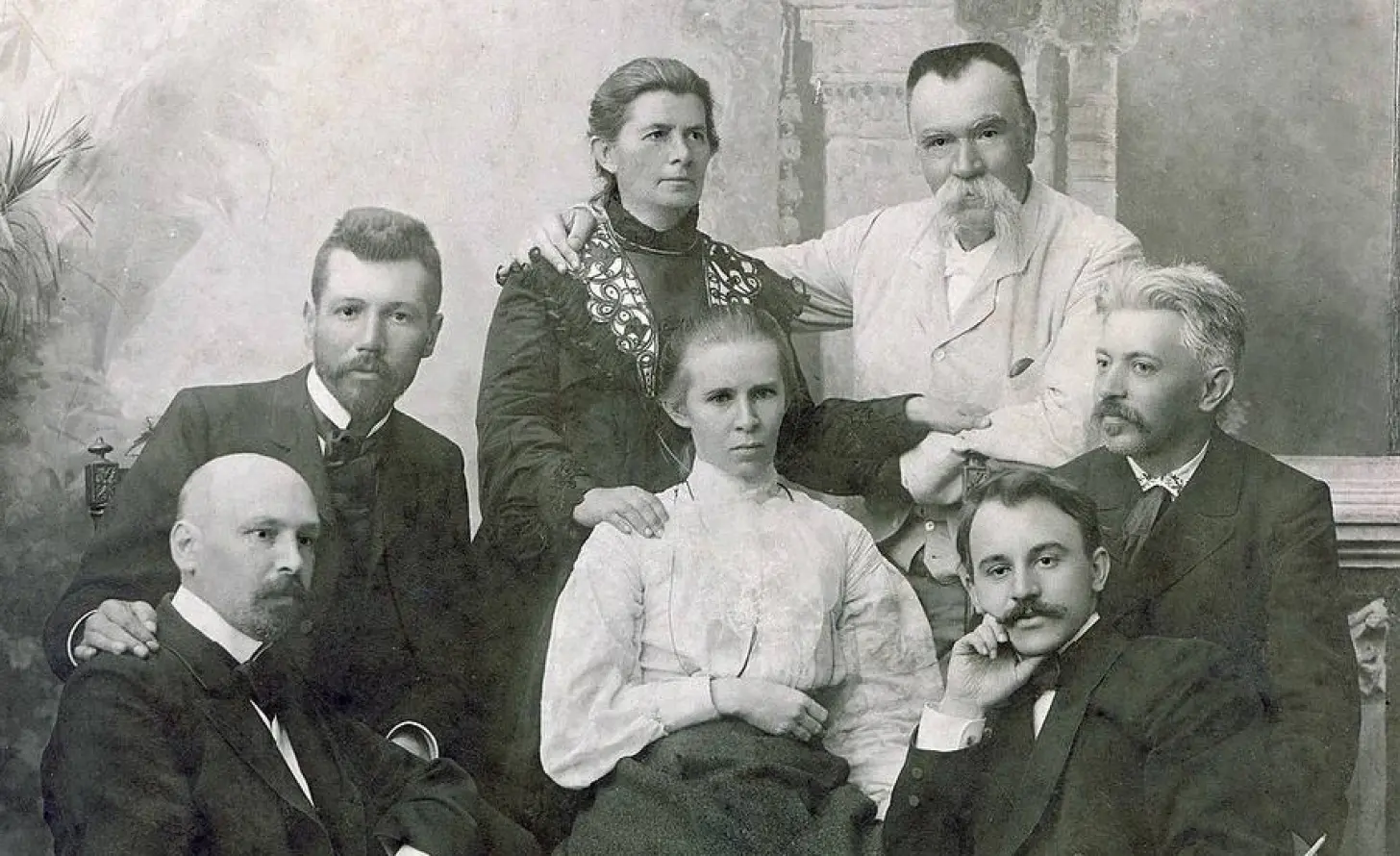
Lesia Ukrainka came to unveil a monument to Kotliarevskyi, Khvylovyi passionately argued with Shevchenko. Later, the Sixtiers fought for a more human image of the Kobzar (Shevchenko), and Stus chose to become a poet in part because he read Franko’s poem Moses.
On stage, the Ukrainian Coryphaei — Kropyvnytskyi, Karpenko-Karyi, Zankovetska — brought the Ukrainian language to the professional theatre after years of censorship. Their cause was carried on by Kurbas, and later Taniuk.
In art, Narbut and Krychevskyi designed Ukraine’s first modern banknotes and coat of arms — what we would now call a national visual identity. Together with Boichuk, they were among the founders of the Ukrainian Academy of Arts. At its successor, the Kyiv Art Institute, students would later be taught by Kazymyr Malevych.
In cinema, the genius of Oleksandr Dovzhenko gave birth to Ukrainian poetic film, inspiring a whole generation of directors: Serhii Paradzhanov, Leonid Osyka, Yurii Illienko. From the generations before us to the present day, this great conversation continues.
The art of Kateryna Bilokur and Mariia Prymachenko is often grouped under the label Ukrainian Naïve. But what makes it “naïve” is only the artists’ lack of formal art education.
Bilokur created not merely masterful floral compositions and landscapes — her canvases were portraits of her soul. She had a phenomenal memory and could reproduce any flower down to the smallest detail. In her paintings, tulips and dahlias, cornflowers and peonies, bloom together. Prymachenko developed her own recognizable style. Contrary to the stereotype of gentle animals, her creatures are often portraits of an epoch: war, the Chornobyl disaster, repression. The stories of Bilokur and Prymachenko are about how it is impossible to not create. For them, the natural world was a boundless source of inspiration, a reliable refuge, an inexhaustible well of images. Today, thanks to these artists, Ukrainian Naïve art is recognised worldwide.
One of Ukraine’s best-known artists, both at home and abroad, Mariia Prymachenko survived the Holodomor, World War II and Chornobyl disaster — and did not lose her optimism or love of life. She was awarded the Shevchenko Prize in 1966 with the support of the Sixtiers, who regarded Mariia as a modern artist and their teacher. Prymachenko’s legacy — including more than 2000 paintings — captivates the imaginations of everyone who encounters it.
In 2025 the New-York duo CHIAOZZA created a project inspired by Prymachenko’s work. 7-meter pneumatic figures, created thanks to Ukraine WOW’s strategic partner Avrora Multimarket, caused a real sensation in Kyiv. You can now see them at the Kyiv Southern Railway Station, and after the exhibition they will tour the United States.
As historian Yaroslav Hrytsak writes, “a word that was spoken does not have as much power as a word that was sung.” Through the lyrics and melodies that parents and grandparents sang to their children, Ukrainians passed down their love for the country and the dream of independence from generation to generation.
Listen to the kobzars, bandurists, lirnyks. Not merely musicians, but storytellers — the living memory of the people. For centuries they preserved the Ukrainian idea in their dumy (oral epic poems). The sounds of the bandura and kobza resounded everywhere: in squares, villages, and fairs.
Their tradition was taken up by Mykola Lysenko — the composer who made kobzar dumy and Ukrainian folklore the foundation of his work, bringing them from the domestic settings to the academic stage. Lysenko recorded hundreds of folk songs, created 10 operas on Ukrainian themes, and opened the Music and Drama School, which was the first in the country to have a department of Ukrainian drama and folk instrument classes.
In 1919 Lysenko’s student, the choral conductor Oleksandr Koshyts, together with the Ukrainian Republican Capella, set out on a multi-year tour. They faced a difficult task — to speak through music about Ukraine as an independent state. The true star of the show in 17 countries was a piece based on a folk song: Shchedrivka. Mykola Leontovych transformed it into one of the world’s most famous Christmas compositions: Carol of the Bells, known in Ukraine as Shchedryk.
50 years later in the United States, Kvitka Cisyk recorded her first album — Ivanku and Other Favorite Songs of Young Ukrainians. The dreams of the Ukrainian people to return home, to their own land, continued to resonate in her unmatched voice.
They still sound just as moving today.
Imagine creating in an era when literally everything is possible. The Ukrainian language lived in theaters, music, science, and books. Social mobility worked, young people challenged the established order, and shaped Ukrainian culture boldly and on a grand scale. Such were the 1920s. Such was the great Ukrainian Renaissance.
Yet by the late 1950s, this period found a different name. From near Paris, Polish editor Jerzy Giedroyc wrote to the prominent literary scholar Yurii Lavrinenko in New York: “Wouldn’t it perhaps be good to give as a general title: The Executed Renaissance. An Anthology 1917–1933 etc. The title would then sound striking… What do you think?”
A striking title was needed for the collection, which presented 37 Ukrainian authors of the 1920s–30s to the world — a stunning legacy of essays, poetry, drama, and prose of an entire generation which, in Lavrinenko’s words, “did not have time to fully blossom, but whose energy and intellect were directed toward the future.” In the end, the name took hold, but the overuse of this definition in émigré circles began to trouble the literary scholar. Moreover, for decades Lavrinenko continued to write equally of the “great cultural renaissance” and the “Ukrainian renaissance.” Let us agree — that does sound far more optimistic. And more accurate.
Of course, the lives of many of that generation’s brightest representatives ended tragically. But should that shadow fall upon the time of their intense work and its fantastically brilliant results? Were their achievements erased by terror? No, and no. Our culture today and interest in that era is the consequence of the Ukrainian Renaissance of the 1920s. We trace strands of our origins from there.
The history of the avant-garde world cannot be imagined without this artist, though after his death his works were subject to destruction and his name — to oblivion. In the 1920s as a professor at the Kyiv Art Institute (the successor of the Ukrainian Academy of Arts), Oleksandr Bohomazov headed the Monumentalism Painting Studio, which became a center of experimental exploration.
In the summer of 1930, Bohomazov’s painting, The Lumberjacks, was exhibited at the Venice Biennale, where it won international recognition: after the Biennale, it traveled to Switzerland and then to Japan. With his very presence, Oleksandr Bohomazov turned early 20th century Kyiv into an artistic capital of Eastern Europe. He is regarded as one of the first abstract artists and one of the world’s greatest futurists; renowned museums across the world consider it an honor to have his works in their collections.
Outstanding modernist artists worked against the backdrop of turbulent events: World War I, the fall of the Russian Empire, and a brief but long-awaited period of Ukrainian independence. Riding an uplifting wave of nationality, they sought to educate a new generation of Ukrainian artists and founded the country’s first institution of higher art education — the Ukrainian Academy of Arts.
It was headed by Fedir Krychevskyi — a painter who stood out not only for his talent but also for his stature and striking looks. A student of Ilia Repin and Gustav Klimt, his triptych Life caused a sensation at the 1928 international competition in Venice.
Among the faculty was Mykhailo Boichuk, whose name became synonymous with the monumentalist art movement of the early 20th century — Boichukism. Boichukists can be recognized by their unique synthesis of Byzantine art, icon painting, Italian Proto-Renaissance, and folk art.
The youngest professor of the Academy was Heorhii Narbut — the artist who created the Ukrainian graphic style. Narbut designed the first banknotes and stamps of the Ukrainian People’s Republic, as well as the coat of arms of Skoropadskyi’s Ukrainian State. Few could rival his mastery of both illustration and typography — skills that shone most vividly in his Ukrainian Alphabet. It is thanks to Narbut that the institution survived: when the Bolsheviks seized the Academy’s premises, he continued classes in his own home.